
The Forest in Performance
A larger case-study and a foil.

[Because it’s been a while, a quick catch up: We were discussing ‘Forest Music’ and the many interpretations of the phrase in the previous issue, and landed on the use of forests in performances as active narratorial agents. We discussed in this context the Surrey Hills performance of Yuuf’s In the Sun. In this issue, we look at two performances. One an amplified and larger version of Yuuf’s effort and another that utilises the forest as a narratorial agent in manner both similar and dissimilar to it.]
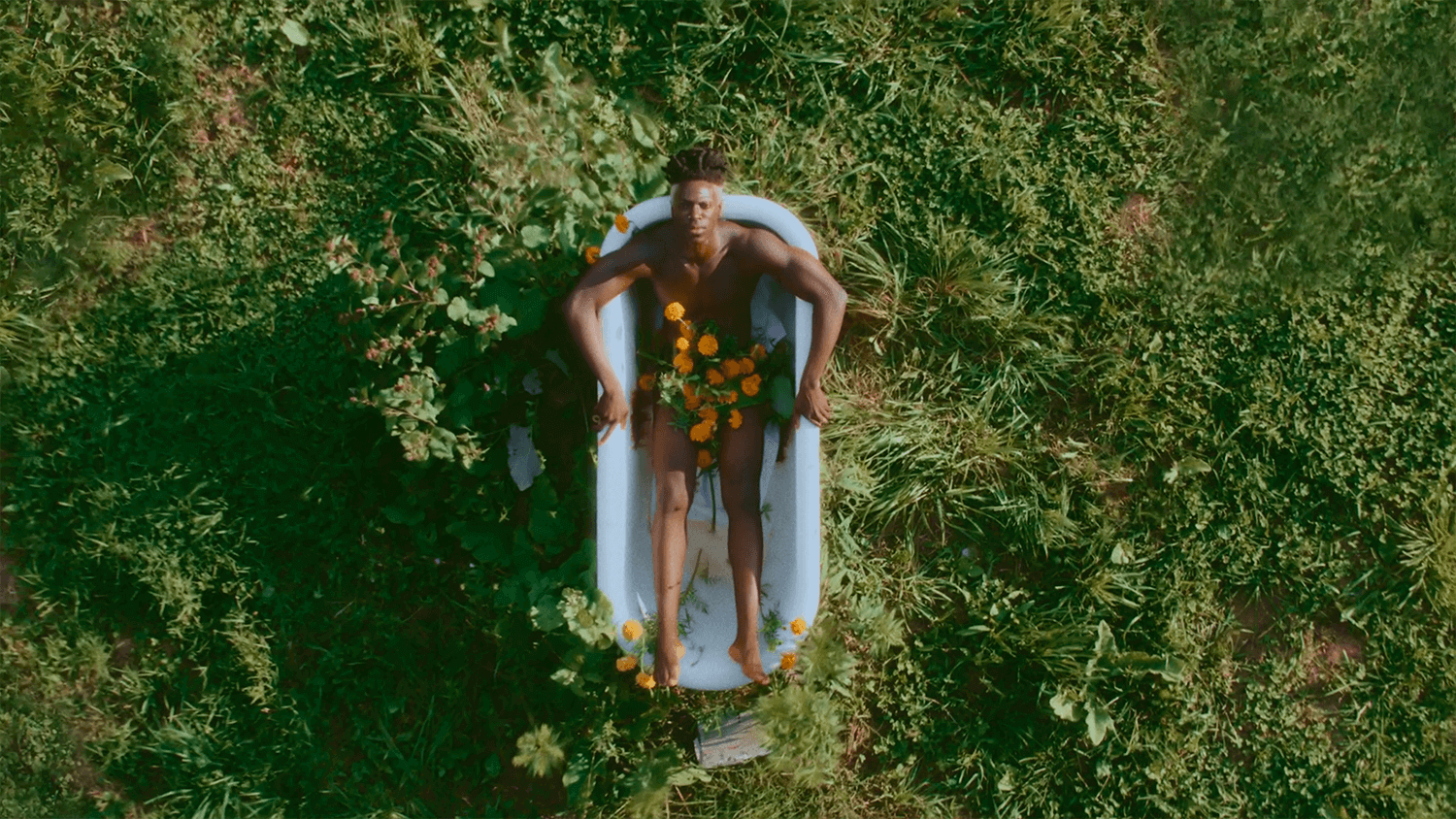
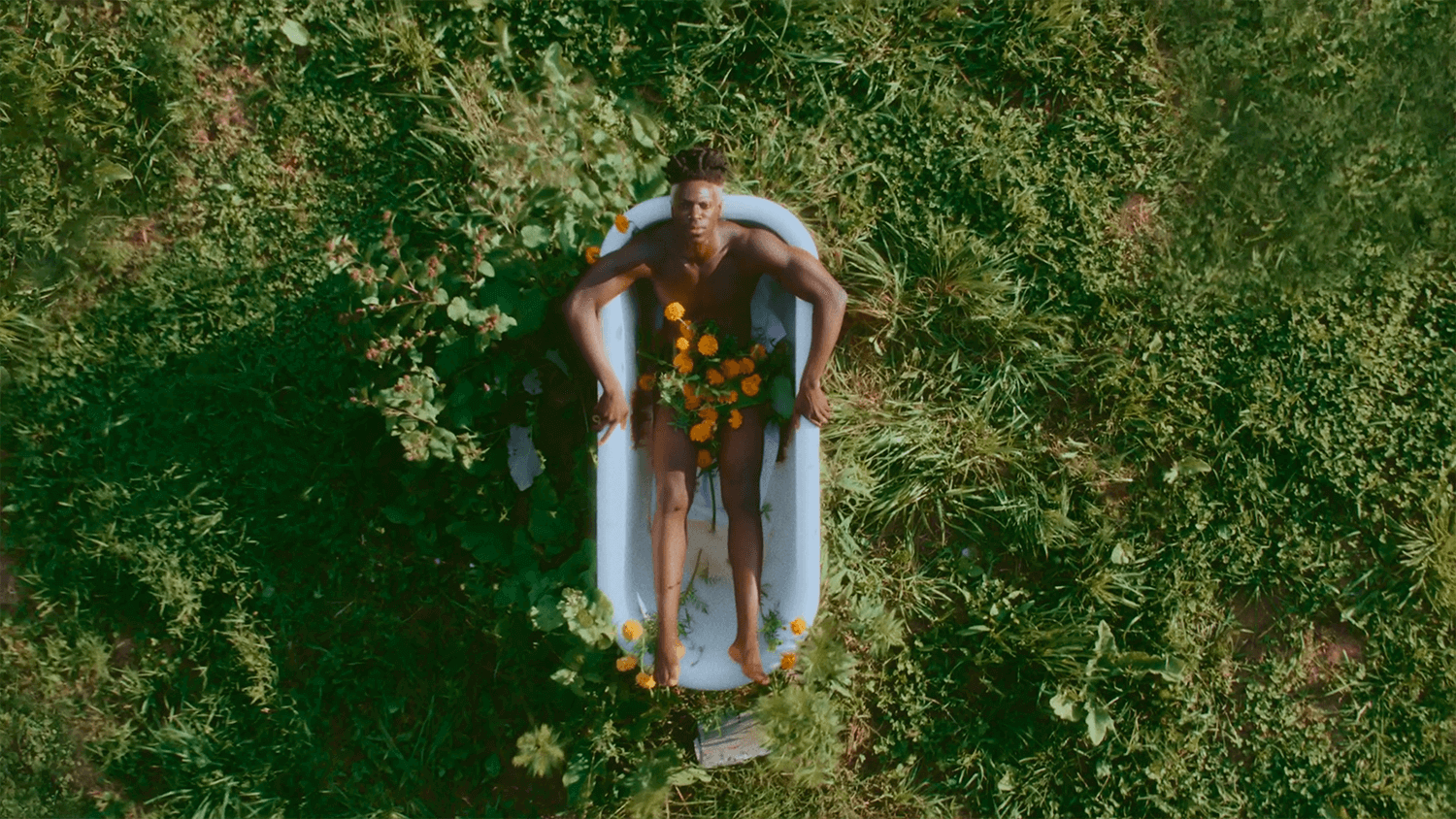
Yes, I’m talking about Moses Sumney again — he’s criminally underrated as a musician, a performer, and most importantly, a storyteller. I’ve always been fascinated by storytelling in music but this man showed me for the first time in many many years that there needs to be neither formula nor forma in musical storytelling. If you want to narrate, you don’t have to write an opera, a musical, or even a rock opera (to which I will also credit complete ingenuity, in its time). You don’t even need to conform to a genre, you can just entirely do your own thing, have the gumption to see it through and watch it become a genuine, pathbreaking artistic masterpiece. Of course, in keeping, you can also choose to perform it in a forest.
Blackalachia was a 2021 performance film, shot over the course of two days, portraying the waxing and waning of one, in the Appalachians. It’s a massive massive project, entirely different in scale to the Yuuf performance we discussed in the previous issue—it isn’t spontaneous, quaint, or unplugged in any way and has all the fixings of an entire narrative effort. There’s a whole lot to be talked about in terms of the performance, the film, and the music but for the purposes of this issue, what matters is that this was so elaborately planned. What this means in terms of the forest is that it was deliberately chosen to be the backdrop of this tremendous narrative process, keeping in mind what it provides to it, and this makes sense in terms of the narratives Moses had been writing at the time and also the life he’d been living (before he became Hollywood’s newest sex god, that is).
A yearning towards solitude and a suspicion towards community and/or modern society was, at the time, a major engagement in his work (see my PopMatters article for a brief look at Aromanticism, in this regard. Grae looks at modern life as the product of consumer capitalism, which hardlines the world as divided distinctly between ends—black and white—and leaves the individual to grapple between these ends for a tolerable equilibrium). Asheville, North Carolina, had become both the backdrop and, perhaps, the facilitator for this vein of thinking and much of the work he produced while living there, removed from the chaos and compulsions of a social, urban life. There are interviews from the time where he indicates just how big an influence the place had had on him.
Blackalachia is a narrativised, film-ised iteration of this life and this bias(?), where the forest, the mountain, and its isolation become the basis for a long contemplation on the temptations, curses, and joys of a solitary, unaccompanied life. Although these are ideas he has explored before, and Blackalachia is apparently the amalgamation of a selection of tracks from Aromanticism and Grae (besides one original track), it actually tells a whole new story, where, for the first time, we’re able to see the impact of the forest on his life and thought. I won’t get into this in as much detail as we did with the previous performance—partly because it's too vast an effort for a newsletter to encapsulate and partly because I’d rather this was a discussion once I’ve convinced enough of you to watch the film.
Right off the cuff, though, I’d like to draw attention to the way this performance begins and the similarity it bears with In the Sun, in the method by which the forest is established as an influence and a character. Along a long shot of the mountains and the forest, Moses is seen running to a stage, which is also set up to mimic a forest space. This is the prelude as well as the opening track, which sets the stage for a narrative of isolation -
Isolation comes from insula, which means island
We know now and will remember for the length of the performance that the forest, an alien and individual agent, has been chosen for what it can contribute to the narrativisation of a long contemplation on solitude.
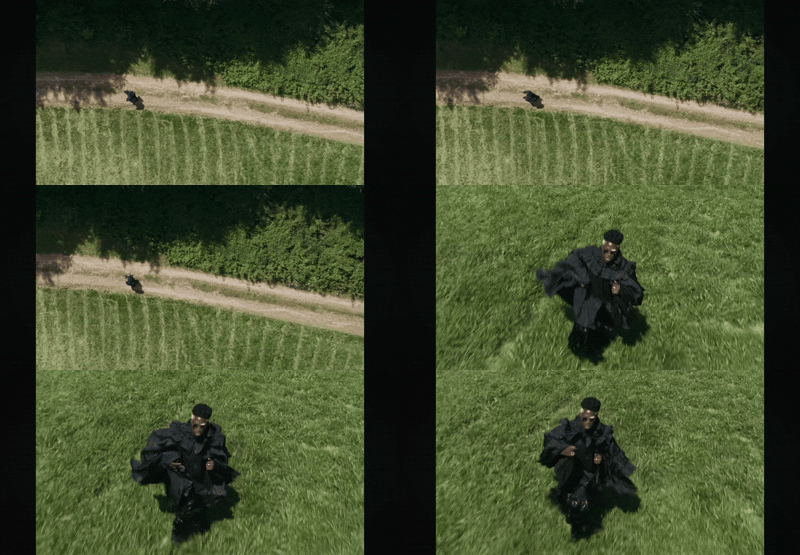
Unlike in In the Sun, the forest does not become absorbed into the sound of the performance. It remains external in its sounds—crickets, birdsong, leaves and undergrowth rustling with wind and contact—and in so doing, remains an agent that the narrator will seemingly bend to. The artistry, of course, is in the delicateness with which each function is highlighted in keeping with the narrative. I have discussed this at length elsewhere so in the scantest terms, in turns, the forest becomes a friend, a looming other, an extension of his person, and a medium for his exploration but throughout, remains for the viewer a symbol of isolation or, indeed, an island.
Another performance I found to have used the forest in a similar sense—although by a very very different method—is FKJ's live performance of Ylang Ylang in 2020, directed and edited by Kasuy. Once again, the arrangement and selection of songs in this performance (including the decision to exclude ‘Earthquake’) betrays the effort to tell a very specific story, in which the forest plays no incidental role. It has been chosen as a setting for what it can contribute to this tale. The method in which the forest is used here is very interesting; the whole thing — 5 tracks, 19 minutes—is recorded in a glass room in what appears to be a house in the middle of a forest and there are, in all, three pertinent angles of shooting. First, and most prominent (being the opening shot) is from outside the glass, looking in at FKJ’s back as he sits at the keys. In this shot, you can see as much forest reflected in the glass as you can see musician and set up. Inasmuch, even though there is an obvious partition between them (unlike in the previously discussed performances), the forest and the narrator come across as one—more so because the glass enables the forest to be reflected on FKJ’s very person. In the Sun did not attempt this and the closest Blackalachia got to this was Moses being on the ground with the undergrowth. The two other shots are from inside the room—one from under his mic and one from the doorway. In both, you can see enough forest to know that the forest surrounds, and in a manner quite similar to Blackalachia, blankets the narrator.
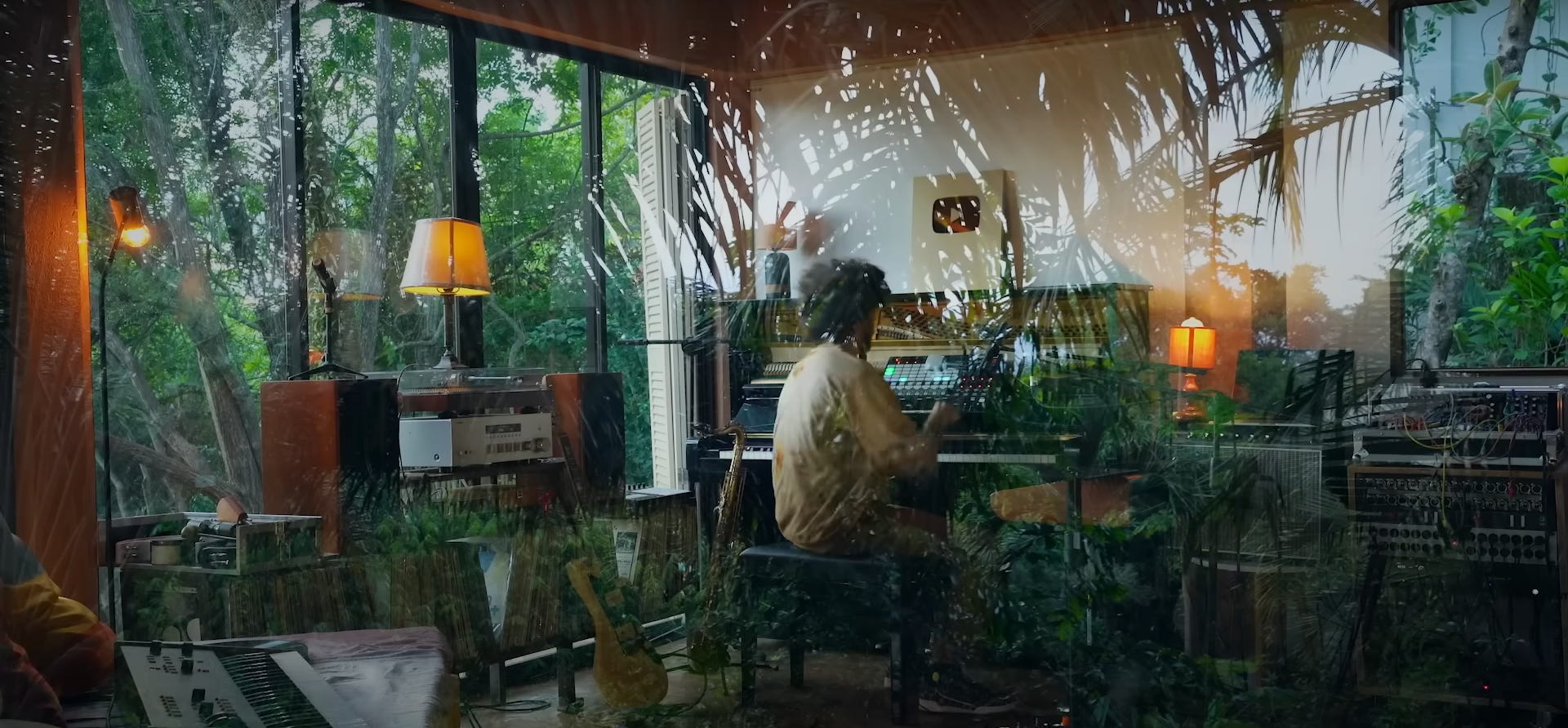
Ylang Ylang, upon first listen, has neither continuity nor anything to do with with isolation (let alone with a forest). But this performance, with its use of the forest as a blanket or a hot box of some kind, makes it evident that the entire album is an almost painful, often introspective meditation by a self-professed loner. The narrator chooses to undergo this in one length, almost like a purging ritual, and chooses this room, surrounded by a forest, so that he cannot leave till he has exhausted this contemplation. [Like the previous performances, there is an introduction to the forest, but it’s much less elaborate and only sees him sit down at the keys, in this room that was initially uninhabited.] 10 Years Ago explains that this hotboxing is a conscious choice today, as it has always been:
Fifteen in my room
I'm a loner playing loud
I'ma stay here so long
I can't feel time this room is on fire
My heart speaking louder…
10 years later
I'm a loner playing loud
Time runs so fast
I'm still the same this room is on fire
My heart speaking louder
It is this intense isolation that makes his ‘heart [speak] louder’ and enables him to truly medidate. ‘Ylang Ylang’, the following track, is in keeping a long house piano piece, that feels very much like an inside monologue. Thereafter, this is made even clearer in the third song, ‘Risk’, featuring Bas. This is an address to an old lover following the rather bitter end of an intense relationship, during which the narrator ‘fought and clawed for an inch’ (at least that’s what I assume this means - English is neither FKJ’s first language nor mine). It’s a dark, emotionally intense space, and the narrator likens it to an ‘abyss’. He says -
I haven't seen light in awhile
Hasn't been bright in awhile
In keeping, the performance space set up for Bas is a mock-forest, with his back against a wall (very similar to Moses’s set up at the end of Blackalachia in ‘Polly’).
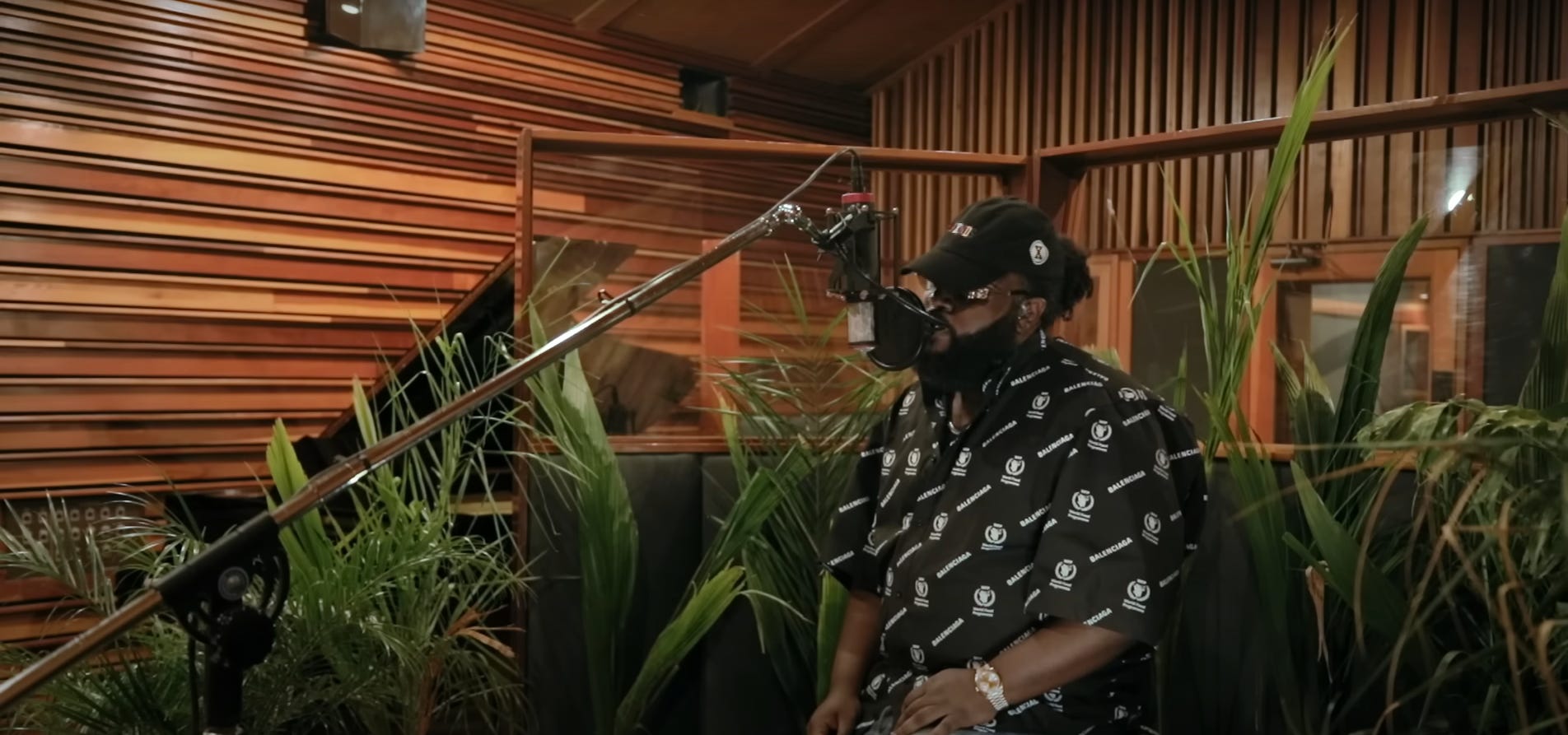
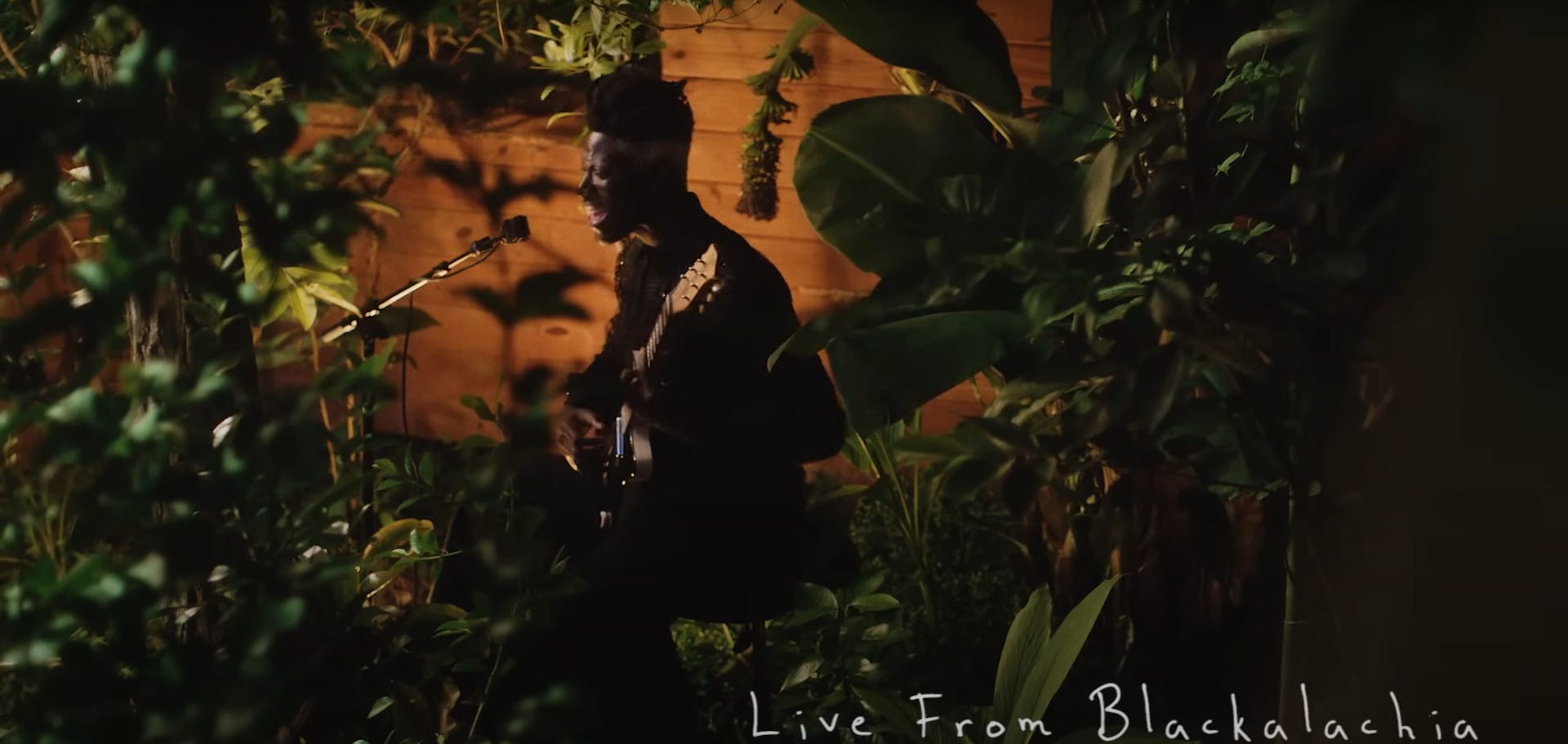
Here, the forest along with its extension also becomes a narratorial tool for FKJ, in that he makes it corner the narrator (Bas, by proxy) and embodies the ‘abyss’ that he feels himself drowning in.
Thereafter, again, with ‘Brother’ and then, very poignantly, ‘100 Roses’, the forest goes back to being a meditative agent that helps the narrator purge himself of these very strong emotions. For context, ‘Brother’ is an ode to his big brother Thomas. In a 2019 Facebook post (and I truly hate how tabloid journalist I sound when I say this), he provides the context for this song —
I always knew i’d write a song about my big brother one day. It’s not easy to describe him. He is a special person. He has his own world. He rarely talks to people apart from his very close ones. He feels people’s energy on a deeper level and if it’s not right, he won’t even look into your eyes. But if it does feel right, he will smile and u’ll be special to him. He taught me so much he doesn’t even realise. That same night in the room the lyrics came straight away and the track was finished.
It’s a love song. It isn’t immediately obvious how much effort a song like this takes but its placement in the album makes that somewhat obvious. The next one, ‘100 Roses’, is even more intense — in fact the most intense song in the entire album. It is a lament, written to the memory of FKJ and (((O)))’s daughter Ayla, upon her demise. Structurally it is as beautiful as it is in intent, and the forest and the glass room truly bring out the complexity and tenderness of this effort. As a matter of fact, it is ‘100 Roses’ that defines the intent of this live version of the album as a painfully contemplative unit, and it is within this context that the performance in a forest makes sense.
Again, this entire business (the forest music issues, that is) has been my effort to locate performances that see the forest participate as a narratorial agent. In these, the forest has its own subjectivity and agency and as a setting, actively participates in the storytelling process. There have, of course, been brilliant music videos in these last few years and very often they’ve been storytelling efforts in their own right, but it’s always brilliant to see artists attempt to create all-round audio-visual performances in long-form, of sorts, and for mass consumption. To pick a setting in keeping with their narrative and with the intent for it to contribute significantly to their pieces is, in every aspect, an effort towards and in itself, art and I truly enjoy coming across these pieces—if only to rant about them on some insignificant newsletter. If you have other such performances in mind—to do with deserts or rivers or the ocean or the city (like Thom Yorke’s Anima), do please let me know so we can gush together in some future issue.
For fun, but somewhat related, here's a video of a cabin being built in a forest from scratch:
https://www.youtube.com/watch?v=CHOAdWP72fI